Schematic of pre-1972 electrical circuit of the Automatic Stick Shift

© 1972 VWoA
Schematic of the electrical circuit for the Automatic Stick Shift on 1972 and later models
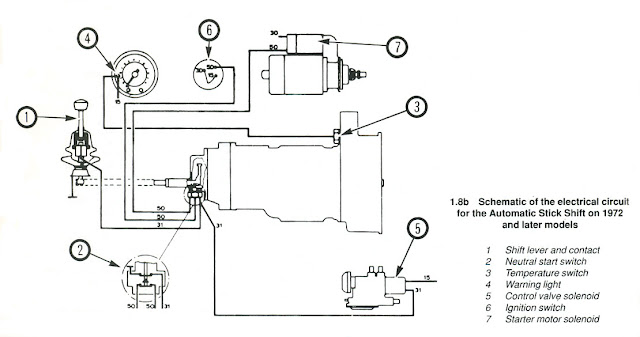
© 1972 VWoA


I collected posters of all colours and all models: Targas, Carreras, SCs, RSs, 924s, 944s, 928s... but the center of my attention was the voluptuous 911 Turbo (or, as I'd remind everyone, "not just a 911, it’s a nine thirty"). This car, in my preteen mind, had everything in the right place. It was the perfect balance of what a sports car should be: friendly but mean, subtle but aggressive, both Bruce Wayne and Batman. Even a few years later when I was taken aback by the revolutionary 959 (this exact poster), I remained true to my first crush.

Road&Track January 1986 The January 1986 issue of Road&Track cemented it for me. On the cover was a line-up of four guards red Porsches led by the one-and-only, the almighty, 930. I can't tell you how many times I read that article. Whenever the Turbo was mentioned, I would intentionally slow my reading and savour the words.
Growing up in rural Nova Scotia I didn't get to see too many exotic cars in the flesh. However, every few months the family would pile into the station wagon and take the hour-and-a-half drive to "the city". This excursion always became a bit of a hunting trip for me. I'd scan the hundreds of cars whizzing by, waiting for a glimpse of a Porsche...just hoping to see an allusive 930. On the rare occasion I'd get a glimpse of one and would instantly become fixated. I wouldn't be able to pull my eyes away. My dad would joke, "Don't stare son! Maybe that's all the poor fella can afford."
As I neared the age of sixteen, I had the inevitable and disheartening realization that my first car would not resemble any of my posters. So I did some homework and learned that Volkswagens were a not-too-distant relative of the Porsche. With a non-existent budget, I found myself in a ten-year-old hand-me-down grey 1980 VW Rabbit Diesel... <sigh>.
Now fast forward about twenty years and several Volkswagens later. In the Appalachians of Pennsylvania, on a winding mountain road cut through a stand of old-growth ash trees, I find myself behind the wheel of a black 1984 930. The cool fall air slipping over the car, down through the huge intercooler and getting sucked into the hungry 3.3 litre. Half excited and half frightened by the savage snarl behind me, I glance at the tach, depress the heavy clutch and reach for another gear.
Later that day I traded my hard-earned savings for the keys.

That day... Obviously when a lifelong dream is suddenly staring back at you, there is a certain degree of surrealism. Amidst the euphoric haze, my most overwhelming impression was that is was nothing like what I'd dreamt it would be. But of course how could it live up to the immortal superhero conjured up in my ten-year-old imagination - after all, it was just a car. No power steering, no power brakes, big turbo lag, unwieldy in the rear... Don't get me wrong, it was in no way disappointing. It was what it was - and it was real!
In Atlantic Canada we store our collector cars through the winter months, keeping them from the perils of snow and road salt. Surprisingly in some ways this is kinda nice. Watching the snow melt, the anticipation of that first spring drive becomes so climactic. Yesterday was that day once again. As the seat bolsters hugged my sides, I felt the direct steering, the turbo lag - the smells, sounds and textures were all the same ...I got that same involuntary grin on my face and I relived that first drive all over again.

| SG | = DS : DW |
| = DS/DW |
So, of interest to brewers, when there is more sugar dissolved in a liquid, like unfermented wort, that ratio is greater than after fermentation. The most common tool used by homebrewers to measure the relative density of a liquid is a hydrometer (or more properly called a saccharometer).
When measuring SG with a hydrometer you should be aware of the temperature of the liquid - especially when dealing with hot wort. Warmer liquid is less dense so the SG will read lower than it would when brought down to room temperature. This is important since hydrometers are calibrated for a specific temperature. The following is a formula for the SG temperature correction for hydrometers calibrated at 15°C (59°F):
| SG' | = | SG + 1/1000(-2.627634×10-6Ts3 + 2.057793×10⁻³Ts2 - 1.32674×10⁻¹Ts + 1.313454) |
And of course:
| TF = 9/5TC + 32 | ⇔ | TC = 5/9(TF - 32) |
For example, if we have a 40°C (104°F) sample measuring 1.028 in the hydrometer, the formula above tells us that we need to add 0.0068, resulting in a SG of 1.035 - a significant difference.
But not all hydrometers are calibrated for 15°C. So here is a formula for the SG temperature correction for a given hydrometer calibration:
| SG' = SG( | 2.32820948×10⁻⁹Ts3 + 2.04052596×10⁻⁶Ts2 - 1.34722124×10⁻⁴Ts + 1.00130346 | ) |
| 2.32820948×10⁻⁹Tc3 + 2.04052596×10⁻⁶Tc2 - 1.34722124×10⁻⁴Tc + 1.00130346 |
Brewers often use a shorthand unit to describe specific gravity called "brewer's points" or just "points". We drop the 1 and multiple by one thousand (moving the decimal point up three spots). For example, an SG of 1.035 is sometimes referred to as 35 points; e.g. 1.035. So mathematically:
| BP | = 1000(SG - 1) |

The units often used to indicate the amount of sucrose in a liquid are degrees Brix (°Bx) or degrees Plato (°P). There's lots of history as to how these scales were developed and evolved; e.g. the Brix scale is based on the Balling scale (other scales include Baumé and Oechsle). For most purposes, Brix and Plato are interchangeable; e.g. 9.99325°Bx = 9.99359°P. Traditionally brewers use the Plato scale and vintners use the Brix scale. These scales correspond to the percent of sucrose in a pure water solution (by weight). So if we have a 1kg solution that we know contains 90g of sugar (i.e. 910g of water), we would have 9% sugar by weight, that is 9°P, or equivalently 9°Bx.
UPDATE: Most refractometers have been designed for measuring sucrose solutions; unfortunately maltose has a slightly different refractive index (and wort contains some other non-sugar bits that alter the solution's refraction). Every brew is a bit different so one way to estimate the difference is to compare your refractometer with a hydrometer for that particular solution. Typically the refractometer will be somewhere around +2 to +6%. Having to use a hydrometer every time kinda defeats the convenience of a refractometer so most people simply adjust their Brix measurement by 4%.
| Bx' ≈ |
|
= |
|
The relationship between SG and the Brix/Plato scales is not linear, it's close but not quite. Several formulas can be used to approximate this curve. For the Plato scale, here are three functions, from the least accurate to the most accurate: a linear equation (Rule of thumb), a quadratic (Lincoln) and a third-order polynomial (Cubic).
| PRule of thumb = | 1000(SG - 1) | ||
| 4 | |||
| = |
|
| PLincoln = | (-205SG + 463)(SG - 1) |
| = | -205SG2 + 668SG - 463 |
| PCubic = | 135997/1000SG3 - 63034/125SG2 + 11117/50SG - 616217/250 |
| = | 135.997SG3 - 630.272SG2 + 1111.14SG - 616.868 |
UPDATE: Here is yet another conversion formula associated with the Plato scale:
| PCubic2 = | 190.74SG3 - 800.47SG2 + 1286.4SG - 676.67 |
Here is a conversion formula associated with the Brix scale.
|
⇔ |
|
|||||||||||||

Conversion formula comparison
As you can see, the Plato "Rule of thumb" formula is the easiest to remember and is within one SG point up to 15°P. However if you are brewing imperials or other high-gravity beers, you are better off using one of the other formulas (which are all pretty close).
This brings us full circle to the reference tables. Rather than take the time to run the formula, a lookup table is quite handy (although it's good to know which formula the table is based on). Here (TODO) is one that I made and keep with my refractometer. I also use a clear sheet protector to save it from any inadvertent mash splash.
Here are two calculators that use the formulas described above:
|
||
| Brix (using a sucrose refractomer): | °Bx
()
|
|
| Adjustment (for a maltose solution): |
%
()
|
|
| Specific gravity (SG): | ⇔ points | |
|
||||||
| Specific gravity (SG): |
|
|||||
| Hydrometer calibration (Tc): |
|
|||||
| Temperature of sample (Ts): |
|
|||||
| Correction (ΔSG): | ||||||
| Corrected specific gravity (SG'): | ⇔ points | |||||
| Plato: | °P(Rule of thumb) | |||||
| °P(Lincoln) | ||||||
| °P(Cubic) | ||||||
| Brix: | °Bx | |||||


