Tuesday, July 24, 2012

Faulty Ignition Switch

1 911.613.011.06 Ignition switch, mechanical portion
1/1 911.613.125.00 Buzzer contact
2 911.613.017.00 Ignition switch, electrical portion
3 - Key
4 911.347.359.01 Reinforcement plate
5 999.219.017.02 Shear bolt (x2)
6 911.613.169.00 Washer
7 911.613.160.00 Rosette
L
ike most vintage Porsche owners, I found myself dealing with a faulty ignition switch. For the last year or so, intermittently it had not been working, then intermittently it worked, and finally it became a bit of a lottery. All key positions were functioning except the last click - engine start.

After reading about the common failure of the electrical portion of the ignition switch (#2 in diagram), I overnighted a replacement. Grabbing my favourite Porsche DIY book - Wayne R. Dempsey's 101 Projects for Your Porsche 911 - I flipped to page 212, Project 91 - Replacing Your Ignition Switch (Google Books and Pelican Parts have some of it online - but you really should buy the book!)

My first challenge was to remove the two shear bolts (#5 in diagram). A shear bolt is a type of security fastener with a head that breaks away after tightening to prevent easy/criminal removal. After some careful drilling and using a Mastercraft GraBit I managed to back out the bolts without needing to remove the steering wheel.

Removing the shear bolts

With a glowing sense of accomplishment I installed the new switch... and had the same problem.

With a now deflated sense of accomplishment, I deciding it would be wise to actually diagnose the problem. First I checked all ground straps and battery terminals. Then I decided to test for power at the solenoid. The main line showed a strong 12.4V but the other two wires were flat when the key was turned to the start position - so I knew it likely wasn't my starter/solenoid.

I then tested the electrical portion of the ignition switch separate from the mechanical portion (what I should have done to begin with) by turning it with a Phillips screwdriver... Eureka! the engine roared to life. I now knew it was the mechanical portion (#1 in diagram) that was faulty.

Looking closely at it, I noticed it wasn't turning quite far enough, maybe 15° short of the full start position.

After several days of driving with the electrical switch swinging by my knees and a Phillips stubby in the ash tray, I figured I either need to dish out the $600-700 for a new ignition switch or try to repair the one I had. If I were to buy a new one I'd need to open it up to rekey it, so I decided to disassemble the old one as practice with hopes of maybe finding an easy fix.

To release the key barrel/tumbler, I used a 1/64" bit to drill out the single pin. With the barrel out I could see it was showing some age and was a bit sloppy.

At the tail-end of the tumbler there are two plates that turn with the key - the thicker outer one turns with the key and the thinner, inner one turns a bit out of sequence. Mine were turning at the same time.

In a functioning mechanism, when turned clockwise, a spring-loaded pin clicks into a hole and turns the inner plate. Then when turned counterclockwise, the pin pops into a notch on the outer disk, preventing it from being turned clockwise again until turned all the way back. This "start lockout" prevents the car from being restarted after it's already been started.

Without taking the tumbler apart, I tightened things up significantly by hitting the two pins at the back with a hammer and punch.

To save the next guy (or future me) some trouble, I tapped the pin hole and replaced the pin with a cone point set screw. Also, when installing the ignition back in the car I used regular bolts instead of the OEM shear bolts.

Here are two posts on the Pelican Parts Technical BBS dealing with the same problem:

Wednesday, May 16, 2012

Autostick Electrical Diagrams II

Here are a few more autostick electrical diagrams.

Schematic of pre-1972 electrical circuit of the Automatic Stick Shift


© 1972 VWoA

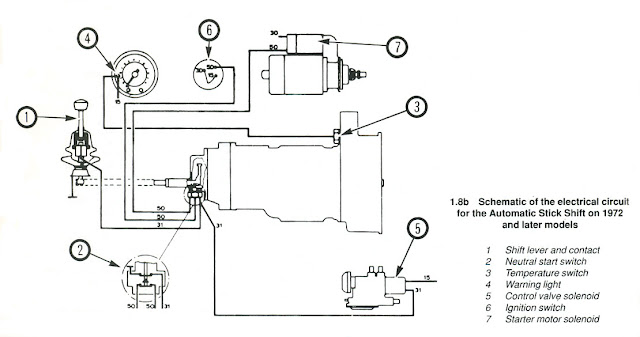
Schematic of the electrical circuit for the Automatic Stick Shift on 1972 and later models


© 1972 VWoA

Autostick Electrical Diagrams

Here are a bunch of autostick electrical diagrams.

Automatic Stick Shift and Rear Window Defogger Circuit for VW Type 1/Sedan 113 — from August 1969 (1970 and 1971 Models)


Automatic Stick Shift, Rear Window Defogger Circuit, and Fresh Air Fan Circuit for VW Type 1/Sedan 113 — from August 1970 (1971 Models)


Automatic Stick Shift Circuit for VW Type 1/Sedan 111 and 113 — from August 1971 (1972 Models)


Tuesday, May 15, 2012

Autostick Oil Pump and Control Valve

Here are a couple handy diagrams from Volkswagen of America.

Dual pump for Automatic Stick Shift


© 1974 VWoA

Control valve for Automatic Stick Shift


© 1972 VWoA

Friday, May 6, 2011

From a Poster to the Real Thing

I
n 1984, at the ripe age of ten, I was immersed and infatuated by the blitz of mid-eighties sports cars being imported to North America. Like every kid, I had the Hot Wheels, the magazines and the posters. In fact, an entire wall of my bedroom was dedicated to car posters. It started with just any "cool car" - but it quickly became exclusive to Porsches. I specifically remember receiving two posters as birthday gifts, a red Testarossa and a white Countach. Both were soon demoted to a lesser wall and eventually rolled up and ungratefully jammed in a closet - unworthy of my Porsche shrine.

I collected posters of all colours and all models: Targas, Carreras, SCs, RSs, 924s, 944s, 928s... but the center of my attention was the voluptuous 911 Turbo (or, as I'd remind everyone, "not just a 911, it’s a nine thirty"). This car, in my preteen mind, had everything in the right place. It was the perfect balance of what a sports car should be: friendly but mean, subtle but aggressive, both Bruce Wayne and Batman. Even a few years later when I was taken aback by the revolutionary 959 (this exact poster), I remained true to my first crush.


Road&Track January 1986
The January 1986 issue of Road&Track cemented it for me. On the cover was a line-up of four guards red Porsches led by the one-and-only, the almighty, 930. I can't tell you how many times I read that article. Whenever the Turbo was mentioned, I would intentionally slow my reading and savour the words.

Growing up in rural Nova Scotia I didn't get to see too many exotic cars in the flesh. However, every few months the family would pile into the station wagon and take the hour-and-a-half drive to "the city". This excursion always became a bit of a hunting trip for me. I'd scan the hundreds of cars whizzing by, waiting for a glimpse of a Porsche...just hoping to see an allusive 930. On the rare occasion I'd get a glimpse of one and would instantly become fixated. I wouldn't be able to pull my eyes away. My dad would joke, "Don't stare son! Maybe that's all the poor fella can afford."

As I neared the age of sixteen, I had the inevitable and disheartening realization that my first car would not resemble any of my posters. So I did some homework and learned that Volkswagens were a not-too-distant relative of the Porsche. With a non-existent budget, I found myself in a ten-year-old hand-me-down grey 1980 VW Rabbit Diesel... <sigh>.

Now fast forward about twenty years and several Volkswagens later. In the Appalachians of Pennsylvania, on a winding mountain road cut through a stand of old-growth ash trees, I find myself behind the wheel of a black 1984 930. The cool fall air slipping over the car, down through the huge intercooler and getting sucked into the hungry 3.3 litre. Half excited and half frightened by the savage snarl behind me, I glance at the tach, depress the heavy clutch and reach for another gear.

Later that day I traded my hard-earned savings for the keys.


That day...
Obviously when a lifelong dream is suddenly staring back at you, there is a certain degree of surrealism. Amidst the euphoric haze, my most overwhelming impression was that is was nothing like what I'd dreamt it would be. But of course how could it live up to the immortal superhero conjured up in my ten-year-old imagination - after all, it was just a car. No power steering, no power brakes, big turbo lag, unwieldy in the rear... Don't get me wrong, it was in no way disappointing. It was what it was - and it was real!

In Atlantic Canada we store our collector cars through the winter months, keeping them from the perils of snow and road salt. Surprisingly in some ways this is kinda nice. Watching the snow melt, the anticipation of that first spring drive becomes so climactic. Yesterday was that day once again. As the seat bolsters hugged my sides, I felt the direct steering, the turbo lag - the smells, sounds and textures were all the same ...I got that same involuntary grin on my face and I relived that first drive all over again.